
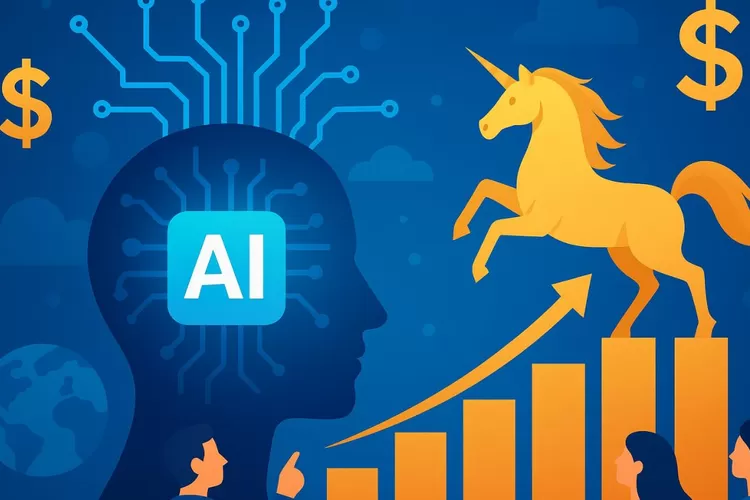
The global artificial intelligence (AI) boom has reshaped the startup ecosystem at a scale never seen before. In just a few years, hundreds of startups leveraging AI technologies have reached unicorn status—private companies valued at over USD 1 billion. Collectively, these unicorns now command a staggering combined valuation of approximately USD 2.7 trillion, underscoring how AI has become one of the most lucrative and transformative industries worldwide.
Much of this growth is driven by breakthroughs in machine learning, natural language processing, and generative AI tools, which are finding real-world applications across nearly every sector. From healthcare diagnostics and autonomous vehicles to finance, cybersecurity, and creative industries, AI startups are proving that innovation is not only accelerating but also attracting massive investor confidence.
Investor Frenzy Fuels Market Valuation
Venture capital firms and institutional investors are pouring unprecedented amounts of funding into AI companies. The widespread adoption of generative AI systems like OpenAI’s ChatGPT, Google’s Gemini, and Https://malaka555.sg-host.com/ Claude has sparked a surge in demand for startups offering specialized AI products and services.
Investors view these companies as not just short-term bets but as long-term engines of growth that could define the future of the global economy. According to recent industry reports, more than 300 AI startups have crossed the billion-dollar threshold, with many of them still in early stages of scaling their business models.
This rush of capital has created an environment where competition is fierce, but opportunities are equally vast. Companies that can differentiate through unique applications of AI—whether in climate tech, personalized healthcare, or enterprise software—are more likely to secure the backing needed to grow into sustainable giants.
Global Hubs Competing for AI Dominance
The rise of AI unicorns is not confined to Silicon Valley. Cities like Beijing, London, Bangalore, and Tel Aviv have become hotbeds of AI innovation. Governments and policymakers are also actively supporting AI ecosystems with funding incentives, regulatory sandboxes, and public-private partnerships.
In Asia, China and India are emerging as major players, producing a significant number of AI unicorns thanks to large talent pools and growing markets. Europe, meanwhile, is pushing AI regulations while still encouraging startup growth, aiming to balance innovation with responsibility. The Middle East is also investing heavily in AI infrastructure, signaling its intent to be part of this trillion-dollar wave.
This global race has positioned AI as not just a technological revolution, but also as a geopolitical asset. Countries that can dominate AI innovation will likely shape the future of trade, defense, and social development.
Challenges Behind the Hype
Despite the enormous valuations, experts caution that the AI gold rush is not without risks. Many startups face the challenge of scaling profitably, as developing advanced AI systems requires immense computing power and resources. Ethical concerns, such as bias in algorithms, data privacy, and the potential for job displacement, also continue to spark heated debates worldwide.
Moreover, some analysts warn of a possible “AI bubble,” where valuations may outpace actual revenue growth. For investors and founders alike, the focus will need to shift from hype to sustainability. Success in this space will depend not just on technological breakthroughs, but also on responsible deployment, trust-building, and long-term business strategies.







0 Comments